Centipede Caberat DP-189-1st-02A
Centipede (revision 4) (Atari, 1980) · Drawing Package · 1 pages · original scan
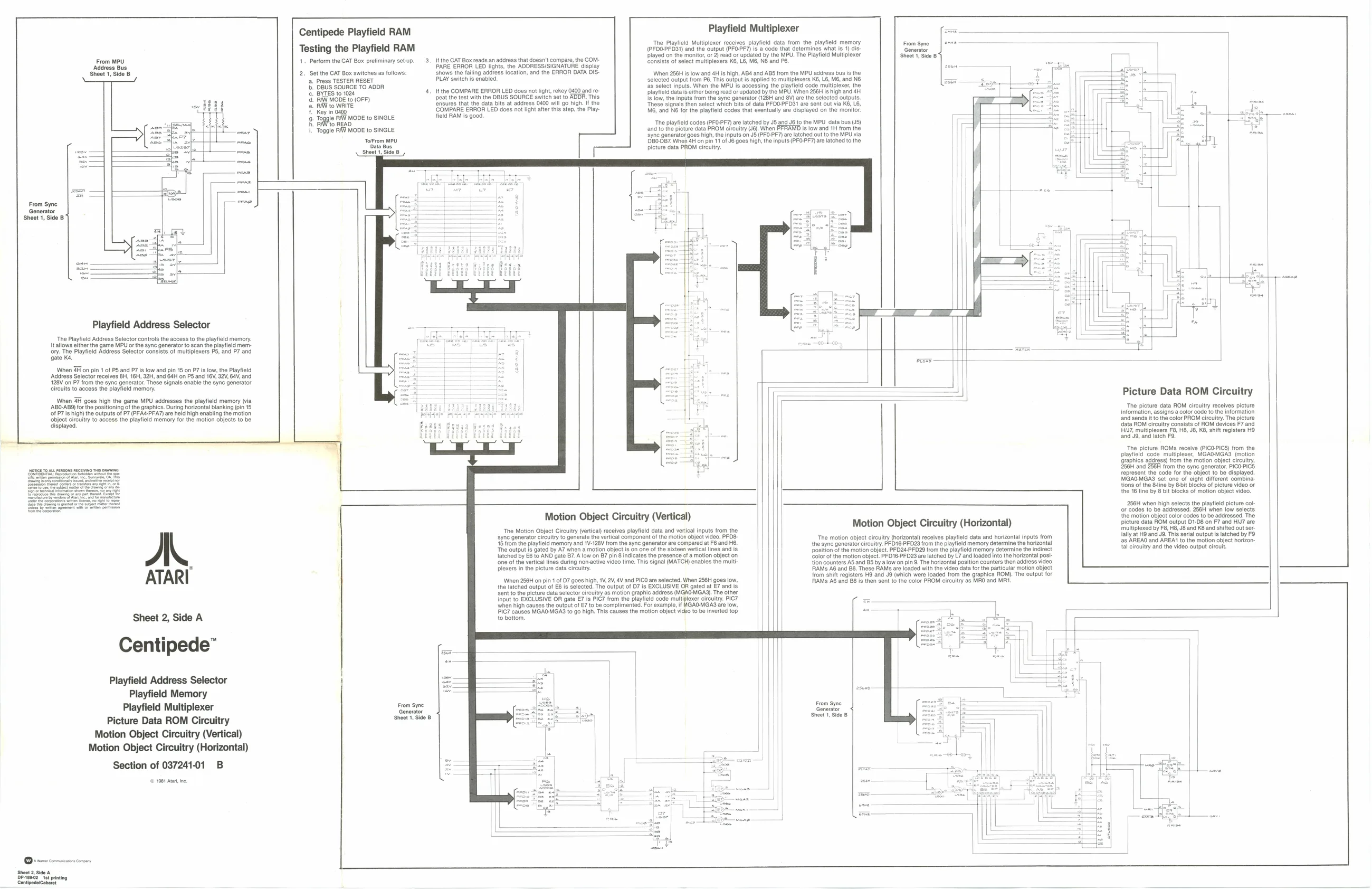
| Centipede Playfield RAM | Playfield Multiplexer | oat | a | _ | ; | |
| : | : | “The Playtield Multiplexer receives playfield data from the playfield memory | From pe | | ome | — | ; |
| Testing the Playfield RAM | (PFDO-PFDS1) and the output (PFO-PF7) is a code that determines what is 1) dis | ‘see: | | |
, played on the monitor, or 2 read or updated by the MPU. The Paylald Multiplexer shea Se
| From MPU | 11. | Pertorm the CAT Box preliminary setup. | 3. | If the CAT Boxreads an address that doesn't compare, the COM: | Ce | re ch ereta Le Mee Ne ant Pe |
| ‘dros Bus | PARE ERROR LED lights, the ADDRESSISIGNATURE splay | tan | ||||
| sheet 1, Side 8 | 2. ‘Set the CAT Box switches as follows: | shows the fling address locaton, and the ERROR DATA DIS | Wen 256H la low and 4s high, ABS and ABS from the MPU across bua isthe | |||
| a. Press TESTER RESET | PLAY switch is enabled, | selected output rom P, This outputs applied to muliploxrs KE, LB: ME, and NE | = |
®. DBUS SOURCE TO ADDR as select inputs. When the MPU is acceasing the playfield code multiplexer, the
| c. BYTES to 1024 | 4. | If the COMPARE ERROR LED does not light, rekey 0400 and re- | playfield data is either being read or updated by the MPU. When 256H is high and 4H |
| d. RIW MODE to (OFF) | ‘peat the test with the DBUS SOURCE switch set to ADOR. | This | is low, the inputs from the sync generator (128H and 8V) are the selected outputs. |
| e. | RWW to WRITE | ‘ensures that the data bits at address 0400 will go high. If the | ‘These signals then select which bits of data PFDO-PFD31 are sent out via K6, L6, |
| f. | Key in 0400, | COMPARE ERROR LED does not light after this step, the Play: | M6, and N6 for the playfield codes that eventually are displayed on the monitor. |
9. jle RAV MODE to SINGLE field RAM is good. ass
f Raft READ ‘The playiels codes (PFO.PF?) ae latched by JS and J6 1 the MPU data bus (5)
| ood | i. | Toggle RAV MODE to SINGLE | and to the picture data PROM circuitry (J6). When PFRAMD is low and 1H from the |
Syne generator goes high the Inputs on J8(PFO.PF7) are latched out to the MPU via = 1DBO.087 When sH on pin 11 of v6 goes high, the inputs (PFO-PF7) are latched tothe eee a sna 8g picture data PROM clu.
From Syne co Generator Sheet 1, Side B
Playfield Address Selector
‘The Playfield Address Selector controls the access to the playfield memory. Itallows either the game MPU or the sync generator to scan the playfield mem ory. The Playtield Address Selector consists of multiplexers PS, and P7 and gate Ks.
When 4 on pin 1 of PS and P7 is low and pin 15 on P7 is low, the Playfield
‘Address Selector receives 8H, 16H, 32H, and 64H on PS and 16V, 32V, 64V, and
‘28V on P7 from the sync generator. These signals enable the sync generator circuits to access the playfield memory
Picture Data ROM Circuitry
‘The picture data ROM circuitry receives picture
Information, assigns a color code to the information
4 ‘and sends it to the color PROM circuitry. The picture ‘data ROM circuitry consists of ROM devices F7 and HIJ7, multiplexers F8, H8, J8, KB, shift registers HO = ‘and J8, and latch F8. nen 4H goes high the game MPU addresses the playfield memory (via ‘ABO-ABS) for the positioning ofthe graphics. During horizontal blanking (pin 15 (of P7 is high) the outputs of P7 (PFA4-PFA7) are held high enabling the motion Object circuitry to access the playtield memory for the motion objects to be ‘isplayed.
‘The picture ROMS receive (PICOPICS) from the
- | playlield code multiplexer, MGAGMGAS (motion {Graphics adaress) from the motion object circuitry, 256H and 256F from the syne generator. PICD PICS | fepresent the code for the object to be displayed. MGAOMGA3 set ono of eight different combing. tions of the Bne by Bit blocks of picture video or {he 16 line by 8 Bit Blocks of mation object video.
256H when high selects the playfield picture col or codes to be addressed. 256H when low selects
| Motion Object Circuitry | (Vertical) | . | oo | . | the motion object color codes to be addressed. The |
" ad Motion Object Circuitry (Horizontal) Bleture data ROM output D108 on F? and HI? are ‘The Motion Object Circuitry vertical) receives playtield data and verical inputs trom the ‘multiplexed by F8, HB, J8 and KB and shifted out ser
| syne generator cicultr to generate the vertical component ofthe motion object video, PEDS- | | | The motion object circuitry horizontal) receives playtield data and horizontal inputs from | faly at H9 and JO. This serial output | latched by F9 |
| 48 trom the payleld memory and 1V-128V from the syne generator are compared at FO and HE. | the sync generator citcuitry, PFDY6PF23 from the playield memory determine the horizontal | a8 AREAQ and AREAT to the motion object horzon- | ||
| ‘The output is gated by A7 when a motion object is on one of the sixteen vertical lines and is | position of the motion object. PFD24.PFD29 from the playfield memory determine the indirect | tal circuitry and the video output circult. |
latched by E6 to AND gate B7. A low on B7 pin 8 indicates the presence of a motion object on ‘color of the motion object. PFD16-PFD23 are latched by L7 and loaded into the horizontal posi- ‘one of the vertical lines during non-active video time. This signal (MATCH) enables the mult | tion counters AS and B5 by a low on pin 9. The horizontal position counters then address video ° plexers in the picture data circuitry. RAMs A6 and 86. These RAMS are loaded with the video data for the particular motion object ‘When 256H on pin 1 of D7 goes high, 1V,2¥, AV and PICO are selected. nen 256H goes low, RAMs A® and BB is then sent tothe color PROM circultry as MAO and MFT the latched output of E6 Is selected. The output of D7 is EXCLUSIVE OR gated at £7 and sent to the pletute data selector circuitry as motion graphic address (MGAO-MGA3), The other Input to EXCLUSIVE OR gate £7 is PIG? from the playfield code multiplexer circuitry. PICT _ . when high causes the output of €7 to be complimented. For example, i WGAO-MGA3 are low, a 1 PICT causes MGAO-MGAS to go high. This causes the motion object video to be inverted top | to bottom, Sheet 2, Side A
Centipede”
Playfield Memory 7 Playfield Multiplexer pe Picture Data ROM Circuitry eee Motion Object Circuitry (Vertical) Motion Object Circuitry (Horizontal)
Section of 037241-01 B be From Syne Generator Sheet 1, Side 8